Swami SharanamHistory & HeritageBack To Home

The Eternal Bond

"From the vaults of Sree Padmanabhaswamy to the heights of Sabarimala, the Kulasekhara Dynasty remains the silent guardian of the Dharma Sastha."

Legacy Theme

The Royal Guardians: Pandalam, Travancore & Sree Padmanabhaswamy

Two royal houses stand inside Sabarimala memory in different but complementary ways: Pandalam as the earthly home of Manikanta, and Travancore as the sovereign protector that guarded administration, reconstruction, and ritual continuity.

This page gathers the paternal affection of Pandalam, the Padmanabha Dasa legacy of Travancore, the Mohini lineage of Ayyappa, the 1950 reconstruction, and the archival traces that still help devotees understand why royal memory remains inseparable from Sabarimala.

Earthly familyPandalam remembers Manikanta as the child found by King Rajasekhara and raised in the palace.
Sovereign guardiansTravancore's rulers served as Padmanabha Dasas, protecting temples as trustees rather than private owners.
Sacred ornamentsThe Thiruvabharanam journey keeps Pandalam's bond visibly alive every Makara season.
Modern dutyThe post-1950 restoration kept royal protection tied to ritual continuity and shrine dignity.

The Pandalam Connection

Pandalam is remembered not merely as a kingdom in Ayyappa lore, but as the earthly home where Manikanta was loved, raised, and recognized.

Pandalam Palace
Pandalam Palace: The earthly home of Lord Ayyappa.

According to the Ayyappa Mahathmyam, the childless King Rajasekhara Pandiyan found the infant Manikanta on the banks of the Pamba River and brought him to Pandalam Palace. That adoption gives the royal connection its emotional depth. The shrine may be on the hill, but the Lord's childhood is remembered in the house of Pandalam.

Even now, the eldest male member of the palace is addressed as the Valiya Thampuran and is regarded in temple custom as the Lord's earthly father. During the pilgrimage season, the palace representative stays at Pamba or Sannidhanam, does not carry an irumudi kettu, and does not prostrate before the idol because palace tradition remembers him in the place of the father, not the devotee.

This is why the Pandalam link feels deeply personal to pilgrims. It does not speak the language of state power first. It speaks the language of custody, affection, and remembered family duty.
The Sacred Thiruvabharanam

The most visible gift of the Pandalam Palace is the annual journey of the Lord's ornaments from Valiyakoikkal to Sabarimala.

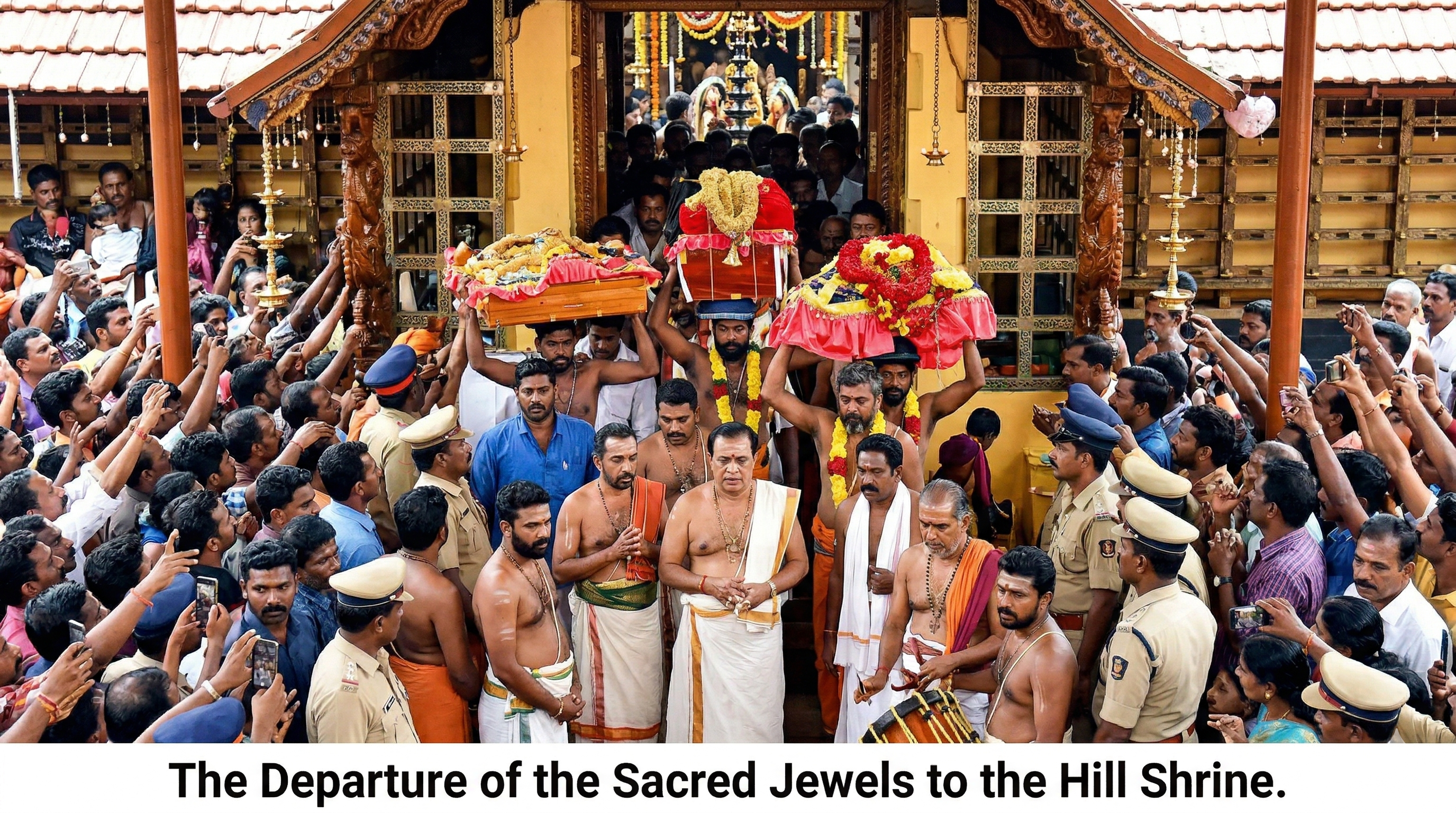
Every year on the 28th of Dhanu, the sacred ornaments are carried by hand in wooden boxes from the Pandalam Valiyakoikkal Temple to Sabarimala. On Makaravilakku day they adorn the deity, and the yogic Lord is received in full royal radiance. Palace memory also holds that the auspicious Krishnaparunthu, the Brahminy Kite, hovers over the procession as a guardian sign from Vishnu for the jewels of his son.

Sacred Thiruvabharanam boxes associated with the Pandalam tradition
The sacred boxes: the Thiruvabharanam is remembered as a royal trust carried with ritual discipline, lineage, and great public emotion.
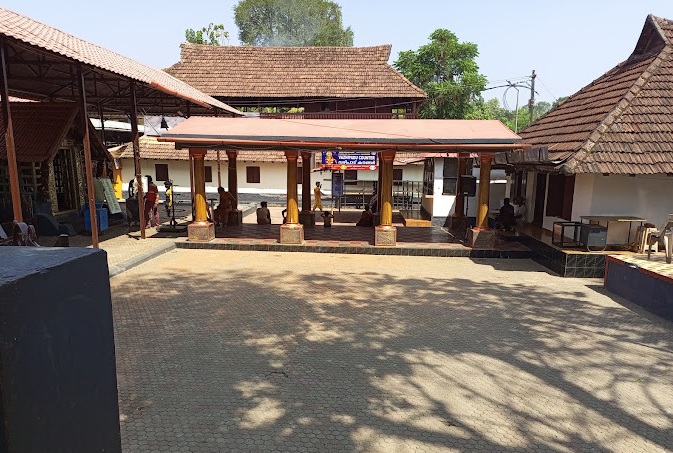
Pandalam Valiyakoikkal Temple associated with Lord Ayyappa
Pandalam Valiyakoikkal Temple: the journey of the ornaments begins here, linking palace memory directly to the Makara season at Sabarimala.

King Rajasekhara's trust

The ornaments represent more than royal wealth. They symbolize the continuing promise of the house that raised Manikanta and still sends him to the hill in dignity each year.

Krishnaparunthu and Makaravilakku

Devotees watch for the Brahminy Kite as a sign that the sacred journey is under divine care. When the ornaments finally reach the Sannidhanam for Makaravilakku, Pandalam's parental role becomes visible to the whole pilgrimage world.

The Thrippadidanam Connection

Travancore’s relationship with Sabarimala becomes clearer when we remember the kingdom’s prior surrender to Sree Padmanabha.

Thrippadidanam Connection
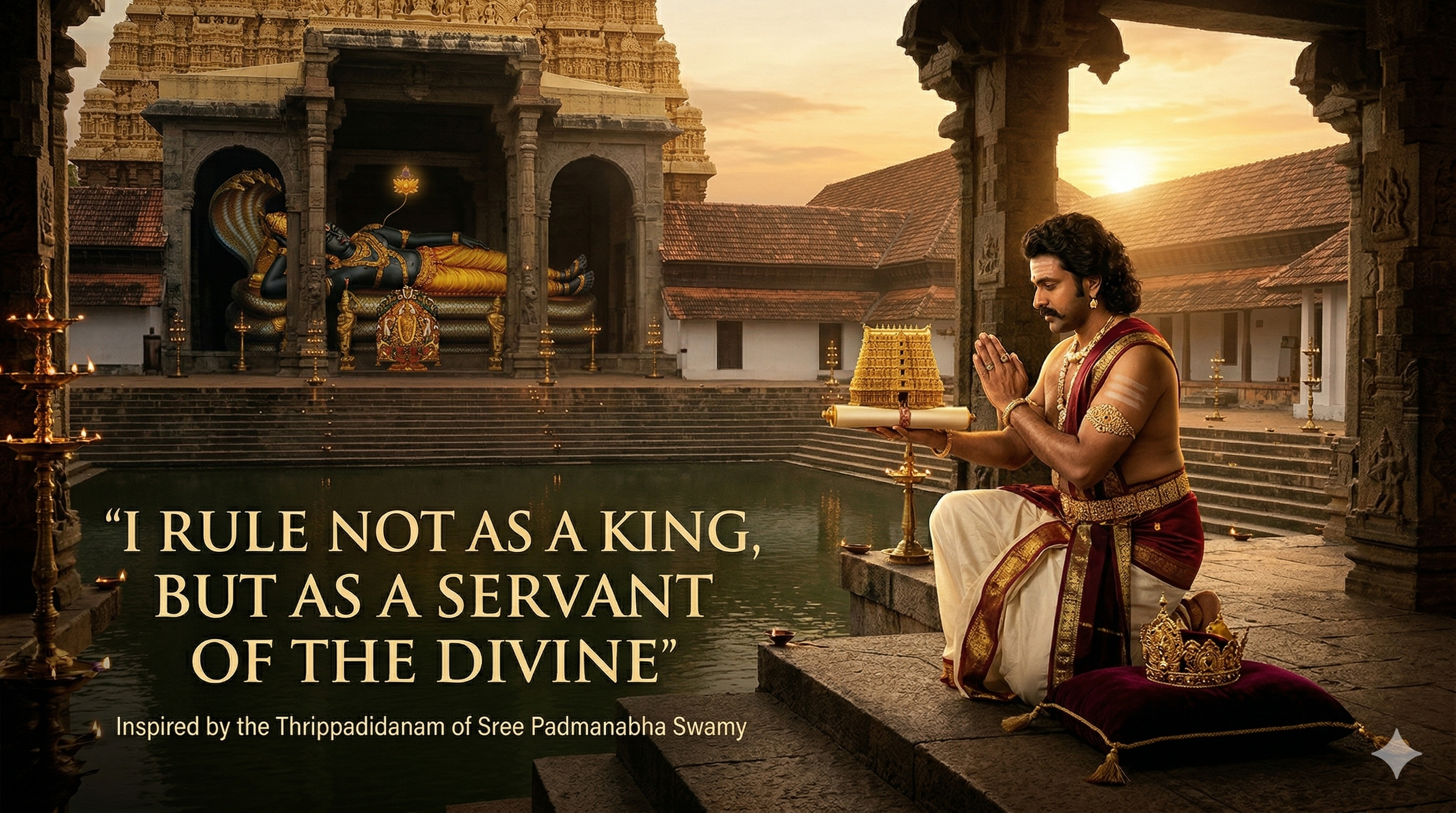
Thrippadidanam: The surrender of the kingdom of Travancore to Sree Padmanabhaswamy.

In 1750, Anizham Thirunal Marthanda Varma performed the celebrated Thrippadidanam, ceremonially offering the kingdom to Lord Padmanabha. From that point onward, the ruler stood not merely as sovereign but as Padmanabha Dasa, the Lord’s servant and trustee.

That shift mattered far beyond Thiruvananthapuram. It recast temple administration as a sacred responsibility rather than a private royal privilege. Later Travancore oversight of shrines, and eventually the institutional framework inherited by the Travancore Devaswom system, carried this same ethic of custodianship into the Sabarimala world.

As Pandalam passed into Travancore’s political orbit, Sabarimala’s ritual continuity increasingly sat inside that Padmanabha-centered framework. The hill shrine kept its own distinct Ayyappa traditions, but the language of protection, duty, and temple upkeep was now inseparable from the state that had already placed itself at the Lord’s feet.

Divine Lineage

The theological bridge between Sree Padmanabhaswamy and Sabarimala is carried through Mohini.

Sree Padmanabhaswamy
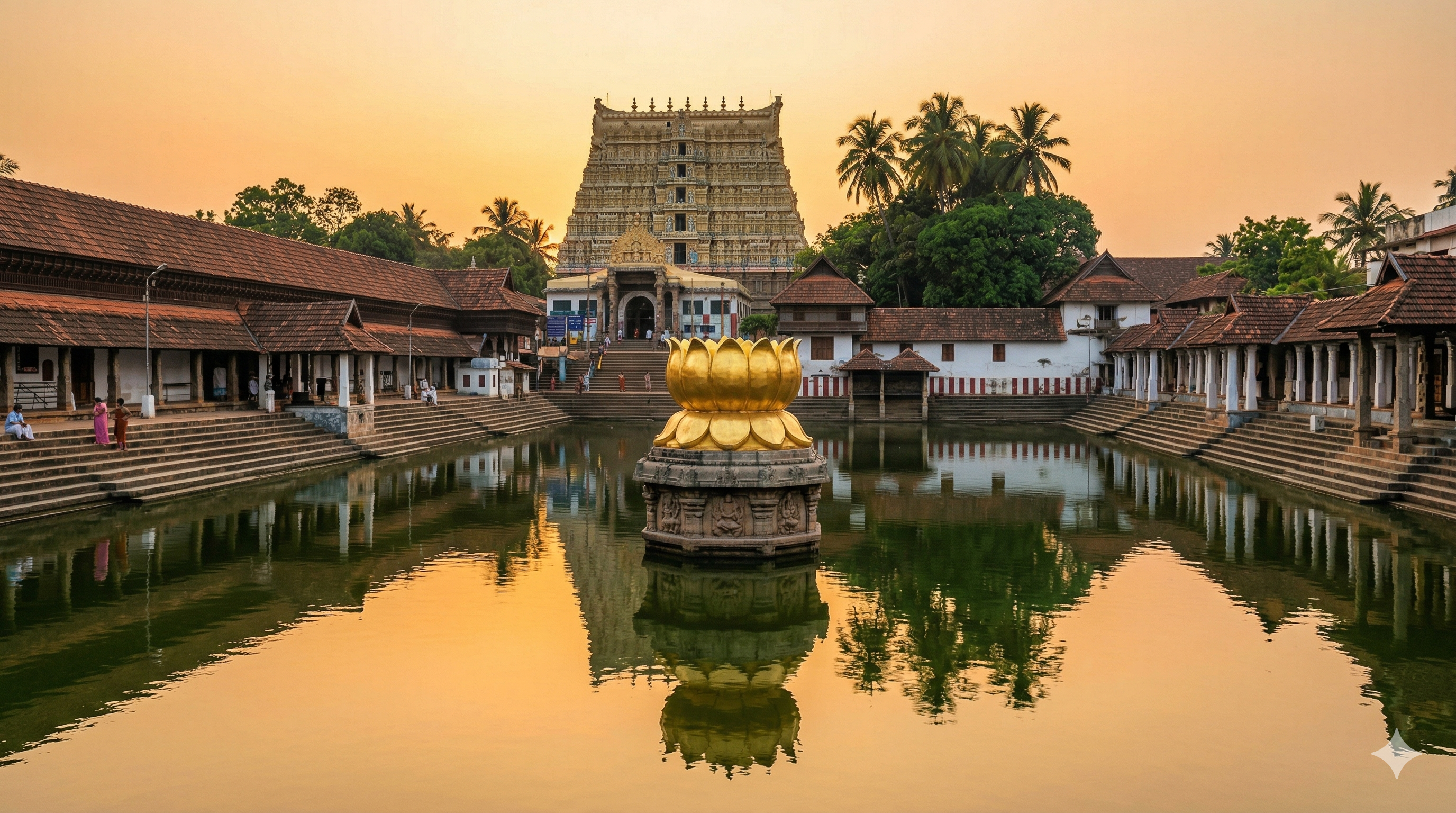
Sree Padmanabhaswamy: The divine lineage bridging the Lord of Thiruvananthapuram with Lord Ayyappa.

In Kerala tradition, Lord Padmanabha and Mohini are not separate divine sources but manifestations of the same Vishnu principle. Sree Padmanabhaswamy enshrines Vishnu in majestic cosmic repose; Mohini reveals that same divinity in transformative form.

Because Lord Ayyappa is remembered as Hariharaputra, born through Shiva and Mohini, the Sabarimala lineage looks back toward the same Vaishnava source revered at Padmanabhaswamy. This is why devotees often speak of one sacred line: Padmanabha, Mohini, and Ayyappa belong to the same devotional family, even when worshipped in different moods and temples.

Seen this way, the royal guardianship of Sabarimala was never only political. It also followed devotional logic. A royal house already consecrated to Padmanabha naturally treated Ayyappa, the child of Mohini tradition, as part of its sacred inheritance and responsibility.

The Spiritual Sovereignty of Travancore

The Travancore kings are remembered as Sree Padmanabha Dasas: rulers who first placed the kingdom under the deity and then guarded temple life as trustees.

Their primary duty in Sabarimala memory is administrative and ritual protection. That includes the sacred-state culture formed after Thrippadidanam, the continuity of temple governance, and the role the royal family played in restoring the shrine after the 1950 arson.

In this sense, Travancore represents the Lord's kingdom: the larger protective frame within which worship, rebuilding, Mandala observance, and public pilgrimage could endure.

The Parental Devotion of Pandalam

The Pandalam kings are remembered as the earthly guardians who received Manikanta as child, son, and prince before he revealed his divine identity.

Their primary duty is custodial affection: protecting the Thiruvabharanam, preserving the palace customs around the Lord's seasonal return, and embodying the father's role in living temple etiquette.

In this sense, Pandalam represents the Lord's home: the house from which the ornaments depart and the human family that never stopped serving him with tenderness.

FeaturePandalam Royal FamilyTravancore Royal Family
RelationshipThe earthly father and family of Manikanta.The sovereign protector and Padmanabha Dasa trustee.
Primary dutyCustody of the Thiruvabharanam and palace traditions.Custody of administration, ritual continuity, and restoration.
Historical statusThe "home" of the Lord.The "kingdom" of the Lord.
Seasonal memoryMakaravilakku procession and ornament journey.Mandala memory, reconstruction, and institutional guardianship.

The 1950 Reconstruction

Royal memory becomes especially visible after the 1950 arson that wounded the shrine.

Sree Chithira Thirunal Balarama Varma
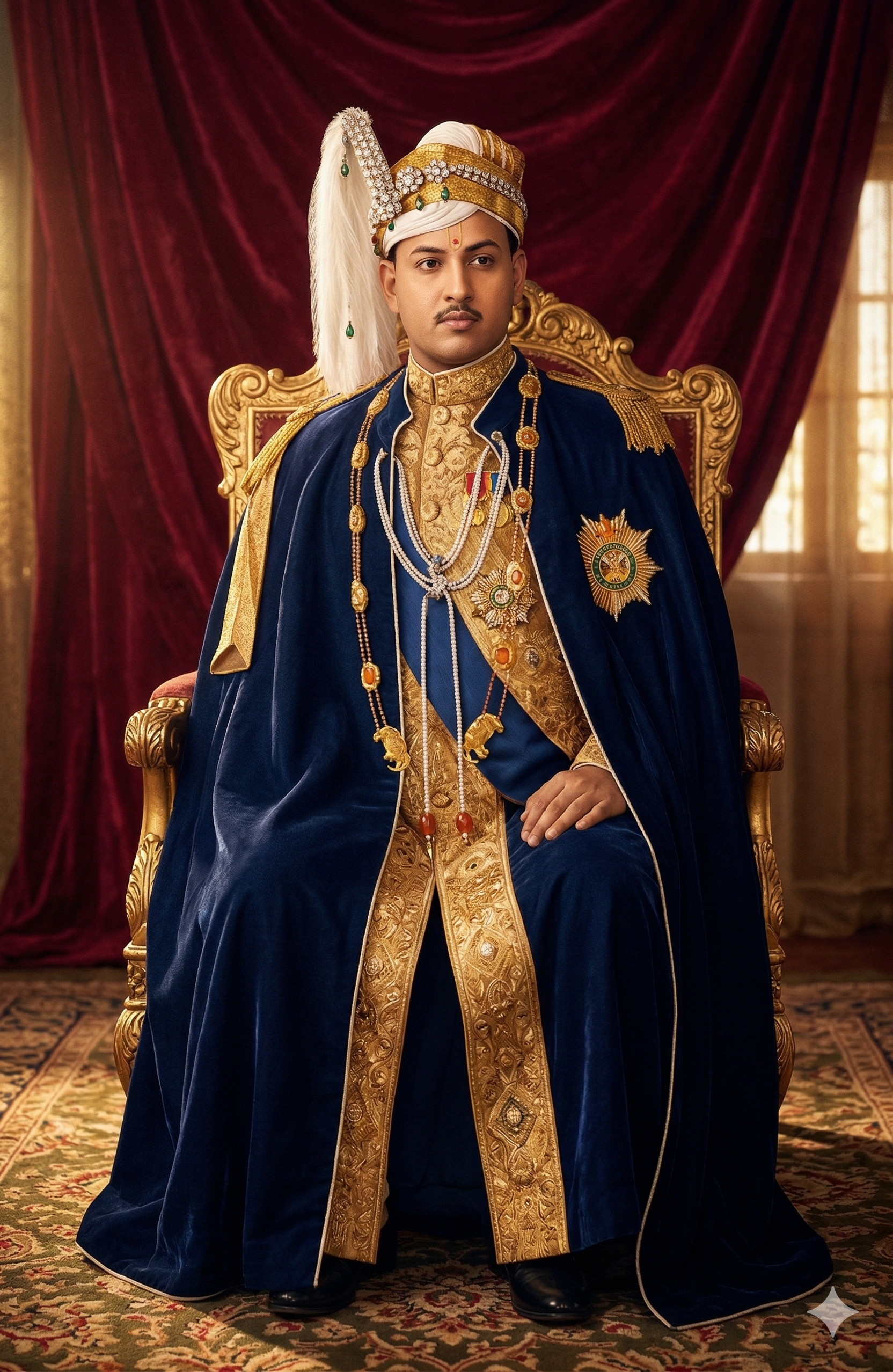
Sree Chithira Thirunal: Key Royal guardian in the restoration of Sabarimala posthumously recognized for profound devotion.

After the fire of June 1950 damaged the temple and the older idol, the rebuilding of Sabarimala became more than a repair project. It was remembered as a ritual obligation to restore dignity at one of Kerala's most charged sacred sites.

Temple memory places Sree Chithira Thirunal Balarama Varma among the key royal guardians of that restoration. The royal role is remembered not only in practical support, but in ensuring that the reconsecration honored Agamic discipline and re-established the sanctity of worship.

This is also where the Travancore legacy feels unexpectedly modern. Royal recollection remembers Sree Chithira Thirunal as an early advocate for preserving the forest environment around Sabarimala, long before "Green Sabarimala" language became popular. The landscape itself was understood as part of the shrine's sanctity.

Restoration As Dharma

For devotees, the post-1950 rebuilding is remembered as proof that royal patronage mattered most when it protected ritual life at a moment of collective grief and helped preserve the sacred ecology of the hill.

Historical Records

The archival memory of Padmanabhaswamy and the documented public memory of Sabarimala reinforce one another.

Historians commonly cite the Mathilakam records when discussing the documentary depth of Sree Padmanabhaswamy Temple. Those records are often used to place Padmanabhaswamy securely in written memory by 1304 CE, showing how deeply the temple already stood inside Kerala's royal-administrative world.

The Travancore State Manual gives a complementary glimpse into Sabarimala's public prominence. In its early twentieth-century account, it notes that more than 10,000 pilgrims visited Sabarimala during Mandala Pooja in 1906, a striking sign that the hill shrine was already a major organized pilgrimage under the Travancore state.

Record traditionData pointWhy it matters here
Mathilakam recordsPadmanabhaswamy is commonly placed in documentary memory by 1304 CE.It shows that the royal-temple world centered on Padmanabha had deep archival roots long before modern Travancore.
Travancore State ManualMore than 10,000 pilgrims are noted at Sabarimala during Mandala Pooja in 1906.It confirms that Sabarimala was already a major pilgrimage institution within the Travancore sacred landscape.
Palace and temple memoryPandalam custom and post-1950 recollections keep the royal bond active in ritual life.It shows that royal memory is not only archival. It remains visible in living practice.

Royal Patronage And The Pathinettampadi

The 18 Holy Steps are interpreted spiritually, but the protected ritual world around them also carries royal memory.

The Pathinettampadi is the threshold of surrender, yet the sanctity surrounding it has long depended on vigilant custodianship. Thiruvabharanam traditions, festival precedence, the careful etiquette of approach, and the insistence that the hill remain ritually disciplined all belong to the same world of royal-backed protection.

That is why devotees who climb the 18 Steps often feel that the royal story is not external to ritual life. Pandalam's parental devotion and Travancore's sovereign guardianship helped preserve the atmosphere in which the devotee could meet those steps with reverence.

Unique And Unnoticed Facts

Palace memory preserves small details that make the royal bond feel intimate and unbroken.

  • The Nirapara tradition: before the Thiruvabharanam begins its journey, the Valiya Thampuran offers a full measure of grain at the palace as a sign of prosperity and thanksgiving.
  • The mourning period: if a death occurs in the Pandalam Royal Family, the Sabarimala temple routine is affected because the family enters ritual impurity, showing how closely palace and shrine are still linked.
  • The palace at Pamba: tradition remembers that the Pandalam kings maintained a small kottaram at Pamba to oversee pilgrim safety and guard travelers against forest threats.
  • Ecological foresight: royal memory around Sree Chithira Thirunal remembers forest preservation as sacred duty, not merely later environmental policy.

Source Note

This page draws together temple tradition, the Ayyappa Mahathmyam's adoption memory, palace customs surrounding the Thiruvabharanam, the documentary importance of the Mathilakam records for Padmanabhaswamy, and the Travancore State Manual's early pilgrim count for Sabarimala.

The intention here is devotional clarity with historical caution. Archival data points are presented in the historically careful form most often used in public-facing temple writing, while palace customs are described as living tradition rather than courtroom proof.